sabato 9 febbraio 2019

One Hour Wargames Scenario 6: Flank Attack

Salamanca lite...


I played One Hour Wargames Scenario 6: Flank Attack (1), which is inspired by the battle of Salamanca. Salamanca was a battle driven by surprise, and this element can't be attained in a wargame scenario, so the scenario is slightly different from reality.

I used this battle as a sort of playtest for my fast Grande Armée rules. I left Command and Control rules aside, including the impulse system, and I just tested the skirmish, artillery, movement and close combat rules. The game was therefore played with the normal OHW turns.

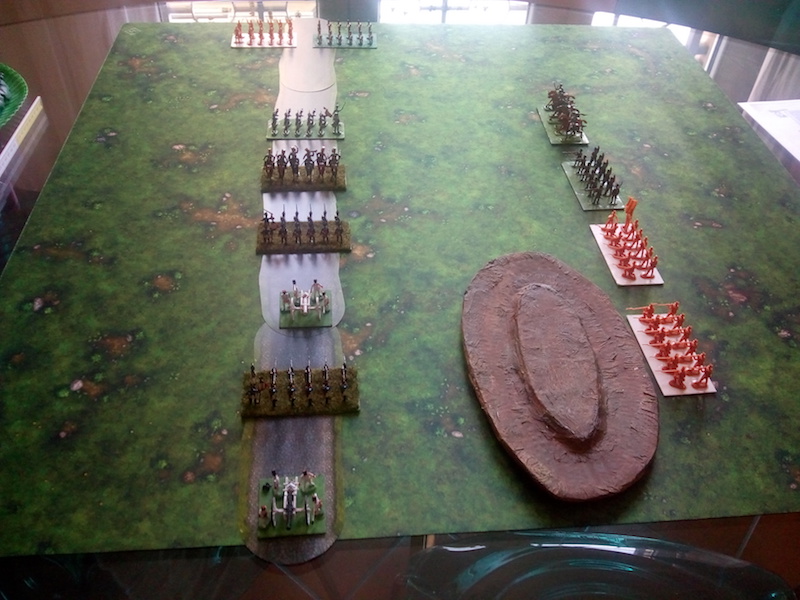
French forces on the march, while British troops threaten their flank

Seen from the other side, with the British blocking force

The French had 3 infantry (5SPs Sk2 each), 1 cavalry (6 SP) and 2 artillery units (Medium). The artillery units in particular were badly suited to a battle where they would have had to move fast. The British instead had 4 infantry (5 SPs SK2 each), 1 light infantry (6SPs Sk2) and 1 cavalry (5SP) unit: the lack of artillery means they have to get close to the French to stop them.
In short, the French had to sacrifice 1 infantry and 1 artillery unit to fend off the larger British flank force, while the rest faced the small blocking force. The initial French attack was repulsed, but 1 artillery and the cavalry unit arrived (the cavalry having previously repulsed their British counterparts) and a new attack managed to open the hole needed to break through and allow 4 units to exit the north edge, given them victory.

The French attack on the British blocking force

In hindsight, the British had to deploy the flanking force closer to the blocking force: this would  have allowed them to be in a better position to stop the French. Instead, the flanking force was farther, and they were too far away to avoid the enemy breakthrough.

The Grande Armée rules worked well, especially the skirmish, artillery and close combat rules: they were easy to play and fast. Regarding movement, I gave up variable movement quite early, and chose fixed movement: turning takes 1/4 of the movement, moving backwards while keeping the front to the enemy takes 1/2 movement, difficult terrain takes 1/2 of the movement.

Probably the same battle could be played inverting the army composition.

I hope to test the command and control rules soon, including the variable impulse turns.

giovedì 24 gennaio 2019

Scenarios For All Ages

I finally bought this from Caliver Books. I've been eyeing it for some months, until I realized that it was best to buy it before Brexit in order to avoid any extra duties that may arise from that...


43 scenarios plus 4 mini-campaigns and 5 mini-games are really good stuff for people who like scenario-based wargaming. Not all scenarios are suited to Napoleonic or 19th century warfare, but they are all interesting reading nonetheless and will provide a nice complement to the OHW scenarios, bringing lots of ideas for playing.

mercoledì 16 gennaio 2019

Fast Grande Armee

How to make Grande Armee faster

In a previous post I said I appreciated the Grande Armée (GA) ruleset a lot, but also saw the need to make it play faster – without going the FPGA way, which doesn’t really speed things up. Now I’ll get more specific on the changes I’m making. In general, I will drop everything that makes the game slow without giving a relevant and key historical upgrade at this level (personal opinion only of course!)
In order not to break any copyright, I’ll just mention each rules section as in the original rules and only note what I change and how, so you still need the rules to make full sense of it.
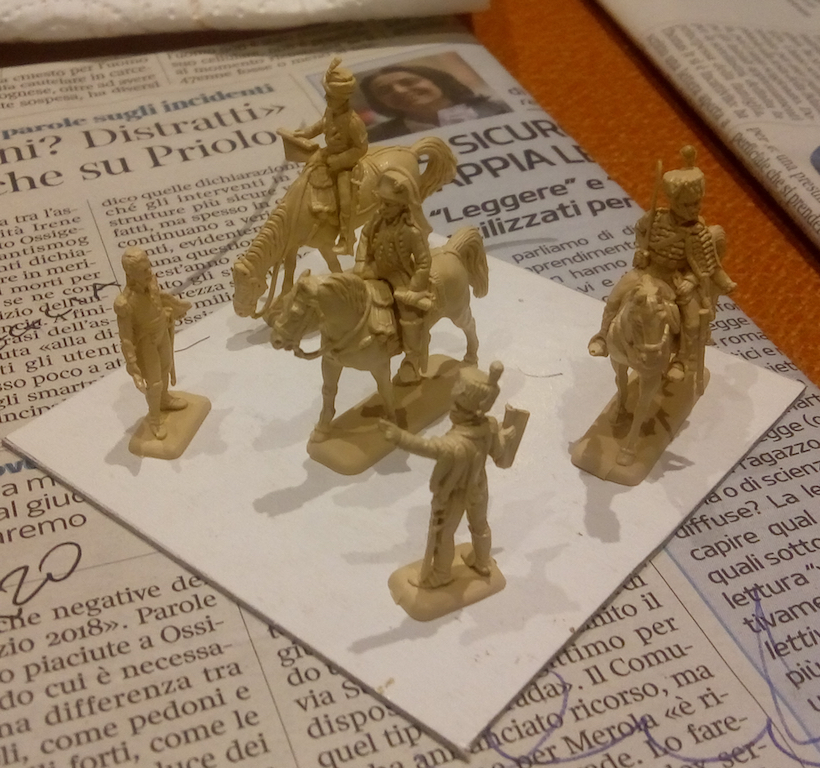
Napoleon's Imperial General Staff - on a 3" x 3" base

A.     Setting up for Play

The main changes here relate to units basing and unit size representation. My units (remember I play mostly with 1/72 plastic minis) are already based for OHW and I’ll retain that basing for both aesthetic and practical reasons.
Units are therefore based as:       
Infantry                  10cm x 5cm (4” x 2”), usually 12 figures in 2 ranks
            Cavalry                   10cm x 5cm, (4” x 2”), usually 6 figures (5 figures in some cases) in 1 rank
            Artillery                  5cm x 5cm (2” x 2”), usually 1 gun and 3-4 figures.
Of course you can play with a more standard (for GA) unit base size of 3”x 3” (7,5cm x 7,5cm) or 3”x 2” (7,5cm x 5cm), I just don’t want to rebase and like them as they are now!
For leaders, OHW doesn’t need any, so I mostly use the Grande Armée basing scheme for 25mm figures, as it’s already appropriate for my minis size:
                  C-in-C                      7,5cm x 7,5cm (3” x 3”), with at least 3 figures
                  Sub-Co                     5cm x 5cm (2” x 2”), with 2 figures
                  Generals/ADCs        TBD, with 1 figure (a small difference from the GA scheme)
Also, in order to be able to play even large battles with a reduced table size and number of minis, I generally consider 1 unit = 1 division or equivalent (instead of 1 unit = 1 brigade). Considering the game is from the Army Commander’s perspective, two levels  down from it is exactly the division level, so it makes sense from that perspective too. For artillery, only major batteries will be represented, or those who had a distinct impact, which may mean a reduction of artillery units in respect to those indicated by a traditional GA scenario (see also changes to section F later).
Cavalry is differentiated between Heavy Cavalry (HC) and Light Cavalry (LC), this has an effect on movement and combat.  It may be difficult to evaluate where Dragoons fit in this… I generally classify them as Light Cavalry because, as explained in the GA rulebook too, they mounted smaller horses than HC, charged more loosely and were not up to Cuirassiers in close combat terms (which is the main distinction at this scale), but feel free to disagree.
For smaller battles, I will retain the 1 unit = 1 brigade or equivalent standard representation, so I can still play all kind of battles.

B. Playing the Game

Will use this as it is, even if for the turn # correspondence with parts of the day I will use the handy FPGA equivalence. Very little will change in actual game terms however: if a game only lasts a few turns, it means the battle has likely started later in the day. And it works for a random choice of starting time and game length for non-historical battles.

C. Weather

Will use this as it is, even if effects on movement will have to be checked in respect to changes to section H.

D. The Command Phase

Will use this as it is.

E. Skirmishing

Will use this as it is. I will evaluate whether Sk2 units should use 10cm range as Sk1, to keep everything more consistent and, therefore, faster to play (unless it breaks balance a lot).

F. Artillery

Will mostly use this as it is, but I will only differentiate between Heavy Artillery (mainly 12pdrs) and Medium Artillery, and generally only related to corps batteries or large concentrations. Light Artillery will be mostly included into units. Distinction between “horse” and “field” artillery will remain for movement.

G. The Control Segment

Will use this as it is.

H. The Movement Segment

This is one of the two sections where I make most of the changes. I’m going with a Neil Thomas’-inspired approach where you can simplify the mechanics and still get most of what is needed to correctly represent what happens, especially given the scale.
First of all, all movement rates will be in cm, not in inches, in order to allow me to use a smaller table. Given that units now are divisions, disruption will be minimal and still give the proper “feel”. I’m still evaluating if cavalry needs to be a bit faster, but I’ll have to playtest it first so for now I won’t change it.
Normal movement is fixed, like in FPGA, and I will retain the distinction between fast and slow foot. Only when crossing difficult terrain or being within 10cm (4”) of the enemy I will use the random roll movement. Therefore, the Terrain Table is discarded.
Units don’t wheel, but pivot on their centers, like in NT’s rulesets. It’s a smart mechanics that gives the same end result but is faster and easier to play.
The 6” rule becomes the 4” rule (4”, or 10cm, is exactly 1BW and I like the correspondence). I keep the requirement for units to only move forward or backwards or pivot, but I drop the friction rule that is too time consuming for very little added realism.
Cavalry can’t evade, and Artillery can’t evade. It’s made to simplify two mechanics that are always slow and troublesome to play (for very little added realism at this scale).

I. Combat

This is the other section where I make most of the changes. I generally go for a more “Blucher-like” (but also NT-like, since I feel that’s where Sam Mustafa may have taken some ideas from) approach, even if I’ll retain a few concepts from GA.
As in GA, square up attacker’s base to the defender. No more than 1 attacker per defender’s base side. No more than 2 attackers for each defender, total. Attacker needs to have at least 2SPs left.
Roll 1 die per number of SPs
Add 1 die if (all that apply):          MX brigade not in or attacking towns or entrenchments
                                                       (V) officer using its bonus
                                                       Units is entrenched
                                                       HC vs LC
Subtract 1 die if (all that apply):                 Attacking uphill
                                                                    In difficult terrain
                                                                    Vulnerable (as defined in GA)
                                                                    Attacked by combined arms
Roll dice. Each die scores a “hit” on 4+
If defender is flanked: defender re-rolls hits (once)
Infantry vs Cavalry: Infantry doesn’t retreat, no matter the result. Can’t be flanked, but can suffer combined arms attack if attacked by Cav and Inf on same impulse.
Combat results: basically, the attacker wins the combat if it scores more hits than the defender. If it scores less or equal to the defender, the defender wins. However, if the defender is too weak (has 1SP left), it may prove unable to stop the attacker anyway. The attacker, too, will always suffer at least 1 SP. In detail:

First, check the Defender:
         If Defender more or equal hits than Attacker: Defender loses 1SP. If broken, remove
               If Defender less hits than Attacker: Defender loses #SPs equal to difference in hits. If broken, remove; if not broken, retreat

Second, check the Attacker:
         If Defender more or equal hits than Attacker: Attacker loses 2SP. If broken, remove; if not broken, retreat
               If Defender less hits than Attacker: Attacker loses 1SP, may advance if no defenders remain in contact.

Retreat distance: 3” + difference in SP loss (in inches). For cms: 7,5 cm + (difference in SP loss * 2,5cm)
(example: difference in SP loss is 1; retreat is 4 inches or 10cm)

J. Things Fall Apart

Will use this mostly as it is, but broken/routed units can’t rally: they are instead directly eliminated the moment they are reduced to 0 SPs.

K. The Rally Segment

I will discard this section entirely: units don’t rally during the battle. While I see what the author was aiming for with this rule, it adds a slowing down mechanics with, again, reduced historical relevance at this scale. Simply said, it’s not worth it (personal opinion of course!). Due to this, any training rating for units is discarded.

L. Victory

Will use this as it is, as it still allows rallying at day’s end if the battle is a multi-day one, which I feel is more appropriate.

M. Special Cases

Will use this as it is, if/when needed. Maybe I could amend something, but I prefer to wait unit I need to use anything from this section and see directly if it’s ok as it is or needs some changes. So far I’m not going to tweak anything here.

N. Optional Rules

Will use this as it is, even if I don’t plan to use these optional rules much. Therefore, like section M, I’ll see if they need changes only on an ad-hoc basis, no need to do it now.

lunedì 31 dicembre 2018

A wargaming Christmas... plus 2018 reflections and projects for 2019

2018 is ending and it's time for a small tradition I've seen over the various miniature wargaming blogs... that of reflections on what has been done in this year what projects are ahead for the next one!

First of all, I'm closing the year with a truly "wargaming" Christmas... a short illness prevented me from actually setting up and playing a game these last few days, but this truly was  a Christmas where presents took the form of wargaming minis and equipment...

I received several 1/72 Napoleonics sets from various manufacturers (Plastic Soldiers Review for each is linked so you can see what's inside):


Zvezda is surely doing some outstanding job, producing excellent sets that truly stand out in terms of historicity and sculpting... I already had their beautiful French Voltiguers, and I'm sure to take more sets from them in the future.


The Italian company has its headquarters near my home city and I visited them once. The French Dragoons are a truly excellent set and the French Imperial General Staff is a nice addition (too bad the other command sets aren't up to this standard, even if I'll take them sooner or later anyway...). The Prussian Cavalry (actually dragoons) set is described on PSR to have several sculpting and size issues and I had some doubts before, but they cover an interesting subject that isn't easy to find elsewhere and after seeing them in my hands I feel they are not bad at all. Probably the only real thing that stands out negatively is the horses' poses - some are a bit ridiculous, but that won't be enough to stop me using and painting them anyway!

All these sets complement the ones I had taken in November (Waterloo's 1815 very good Prussian Hussars, Hat's Austrian Artillery and Austrian Cuirassiers), I feel I'm reaching a very good stage in variety and quality.

Plus, I also received a modeling kit (I never had a complete one and used less-than-perfect means for cutting sprues and flash...) that is already being put to good use!


Finally, since this remains a blog that started over Risorgimento Wargaming, I've recently purchased this book on Risorgimento battles. Not many details over each single battle, but a good, quick overwiev of the campaigns and some very interesting reflections on the armies and how they fought.


Reflections on 2018...

I rediscovered miniature wargaming in 2017 (IIRC) thanks to Neil Thomas' One Hour War-games and started this blog in February this year... 24 posts (25 with this one) were written, with a lull during the summer months due to other commitments. Not bad for a first year... I started some projects, continued some, left others and started some more; overall it was satisfying because it build a small niche for personal fun. I discovered more rulesets I didn't know and lots of wargamers that play great games and paint even better. My blog is small, just a reflection of the few time I can devote to this hobby nowadays, but it was really exciting because, as they say, the best is yet to come...

...and projects for 2019

And speaking about what is to come, what are my projects for 2019?

I will probably leave the Colonial project aside, at least for a while. I'm currently concentrating on Napoleonics and want to playtest my ideas for fast Grande Armee. I aim to recreate the battle of Dresden (1813) this year, I already have most minis (I just really miss some French Young Guard, Austrian Grenzers and Grenadiers and a few other smaller bits) but I need to paint them. As usual, I'll play even if not everything is painted and even if not everything is correct (I prefer playing with proxies than not playing... because after all playing remains the real aim!).
Still, most of my time will be about painting the minis for that - and in the meanwhile play smaller games to test the rules and see if they really fit my needs.

Finally, I hope to at least write some more scenarios for Risorgimento battles, maybe continuing the Barolo campaign I have started this year...

Merry Christmas and Happy New Year to all of you!

giovedì 27 dicembre 2018

Making Grande Armee fast... or, at least, faster...

I've tested my Napoleonics SiP rules a few more times... and as it often happens when you really playtest something, I can now see what it does well and what it doesn't.

Pros: it really is a fast ruleset, that mirrors the original SiP system and gives a more Napoleonic feel. You can easily use it for OHW's scenarios, or for other teasers.

Cons: 
- the shooting rules have to be a bit changed, because they provided for too many casualties. A unit could just stay back and shoot the enemy until it breaks, without the need for close combat, because it's safer and usually assures destruction, even if not quickly. Close combat is useful only if you are in a hurry and/or if the enemy is already really weakened or in a bad tactical situation. Unfortunately, this may be not enough historical, as under this scale, skirmishing fire was a good thing to soften the enemy but close combat was what effectively drove the enemy away. A solution for this would be to reduce the likelihood of hitting for each die by 1: normal 5-6, skirmishing advantage 4-6, ancien regime 6. Or even reduce it even more to normal 6, skirmishing advantage 5-6 and no fire for ancien regime armies (which would actually fire more under close combat circumstances anyway). This would make it more likely for players to choose to close attack when near the enemy, while still allowing the skirmishing effect.

- army command and control. It works fairly well for a OHW- or teaser-like scenario of 10 units each or less without reinforcements, but is less useful when battles are more complex or with more units. Somehow the idea is sound but some of the flavor is lost and if reinforcements arrive, you have to recalculate the number of units each side can control.

Conclusions: good rules for fast, small games, but only if you take the modifications above for shooting. And the command rules may prove unsatisfactory to some players or in some battle scenarios.


Grande Armee rules, by Sam Mustafa
I've been looking for alternatives and I've found the Grande Armee rules, by Sam Mustafa. They are the predecessors of Blucher, and they are not supported anymore, but I think they do lots of things better than Blucher - but not everything. The way it deals with skirmishing, in particular, is excellent, better than in Blucher and fits my needs perfectly. Still, some other parts are less good, like the close combat rules, where Blucher definitely shows improvements. Also, the movement rules are a bit cumbersome. The command system is sound and interesting. I guess Sam moved to Blucher to improve the game - and he did in several areas - but also had to sacrifice some historicity (the volley fire part in Blucher is no more a part of close combat, which doesn't really make sense...) for more gamey solutions that would appeal more to wargamers.

In order to get a ruleset for larger battles, that would be less easy to fight with Napoleonic SiP, I'm toying with a fast versione of Grande Armee (no, not the Fast Play Grande Armee system that Sam Mustafa once wrote, because the rule changes don't give the same feel and don't appear "fast" at all...)

Therefore, I think I'll use the Grande Armee framework, starting with the Command and Control system, even if I'm thinking about a more elegant way of recording Cps spent than using the counters.

Blucher rules, by Sam Mustafa
The skirmishing and artillery fire part is good and would be used "as it is". For close combat, I would use the system from Blucher, which is more elegant, and for movement I'd use the SiP/Neil Thomas conventions, which make it much faster and straightforward, speeding things up.
Also, I would give up the training rating for units, keeping only the SP rating, just as Blucher does with the élan.

The biggest plus of playing with Grande Armee or Blucher is the great amount of author- and player-made scenarios available, which are easily adaptable to either!

Going to playtest this soon and see if it really works!

sabato 8 dicembre 2018

Small painting update

A short update on my painting. Sometimes it takes quite a lot for me to finish a units, while in other times it takes me just a few sessions: this time I got both things, as I started painting two cavalry units and then left them aside for some months... only to take them back to the painting table and finish them quickly.

Recently painted units

Recently, my painted units included 2 units of French Line Infantry, 1 unit of Polish Lancers and 1 unit of British Hussars. 

Polish Lancers (Esci)
French Line Infantry (Italeri)

The Hussars had a complicated painting sequence... I knew very little of British Hussar uniforms during the Napoleonic Wars, and I started painting them as Crimean War hussars, since that's how they were labeled in their box image (Lord Cardigan's 11th Hussars). Then I read their entry on Plastic Soldier Review and found out the sculpts actually were more accurate for the Napoleonic Wars, not Crimea, but the uniform colors were wrong... especially the trousers. In short, I made a quick search or the correct colors (this mainly impacted the trousers, the bugsby and a few other details and repainted the relevant parts...) and I managed to convert them to the 5th Cavalry Brigade during the 100-jours campaign, with half painted as 7th Hussars and half as 15th Hussars.

British Hussars 1815 (Esci)

Now I will probably turn to artillery, in particular Austrian Artillery. I also have French Hussars, and French Voltiguers mounted and ready for playing and painting... but I still have to decide in which order I'll paint them!

domenica 2 dicembre 2018

Radetzky - Milano 1848

A few days ago I played with my brother at a new boardgame with a distinct Risorgimento theme: Radetzky: Milano 1848, which deals with the "5 giornate di Milano" (5 days of Milan), the uprising which saw the Milanese people start a 5-day unrest from March 18 to March 22, 1848 which ultimately saw Austrian Marshal Radetzky evacuate the city and retreat east towards the Quadrilatero fortresses. During the uprising, King Charles Albert of Piedmont-Sardinia declared war and started the 1st Italian Independence War. 

The game is a cooperative one, with 2-5 players playing the Milanese people against the AI (which controls the Austrians) in a struggle to win city district after city district. Players win if they control 5 districts and the Austrians have less than 5, while Austrians win if they control 5 districts before the Italians do it or if both Italians and Austrians end up controlling 5 districts in the same turn. Austrians also win if almost all their soldiers have been deployed (this happens later in the game if players didn't eliminate them effectively enough). Players have to confront an enemy which starts to send more and more soldiers against them, but they can muster resources (including the historically decisive barricades) in order to limit the enemy moves and turn the tide. The Austrians have a special "Radetzky" mounted counter that moves each turn and makes it harder for the Italians to take control of the space he's in, but also allows some more benefits if he's defeated. Historically, as the historical notes included at the end of the rulebook correctly note, Radetzky stayed inside his HQ, the Castello Sforzesco, and never went outside until the retreat, but the variation in the game allows some interesting game mechanics and challenges for the players.

We played two games, one with basic rules (where we lost) and one with advanced rules (where we won). Good coordination among players can be useful to win the game, and if ends up being too easy (but we felt it was nail-biting to the end!), players can limit communications between them to make it harder to win. Players win individually, not just as a team, but we didn't care for it. If we had done it, maybe it would have resulted in less cohesion and, possibly, in defeat...! Well, in the end it looks like our Milanese were able to overcome their political differences for the common good!

Overall, a good game that I really enjoyed playing!

First game: too many Austrian soldiers (black blocks)
and too few patriots around!

End of first game: Austrians get control of 5 districts,
while patriots only control 3... this time Radetzky wins...

End of second game: a nail-biting victory as Italians control
5 districts while Austrians have 4!