Visualizzazione post con etichetta Rules. Mostra tutti i post

mercoledì 16 gennaio 2019

Fast Grande Armee

How to make Grande Armee faster

In a previous post I said I appreciated the Grande Armée (GA) ruleset a lot, but also saw the need to make it play faster – without going the FPGA way, which doesn’t really speed things up. Now I’ll get more specific on the changes I’m making. In general, I will drop everything that makes the game slow without giving a relevant and key historical upgrade at this level (personal opinion only of course!)
In order not to break any copyright, I’ll just mention each rules section as in the original rules and only note what I change and how, so you still need the rules to make full sense of it.
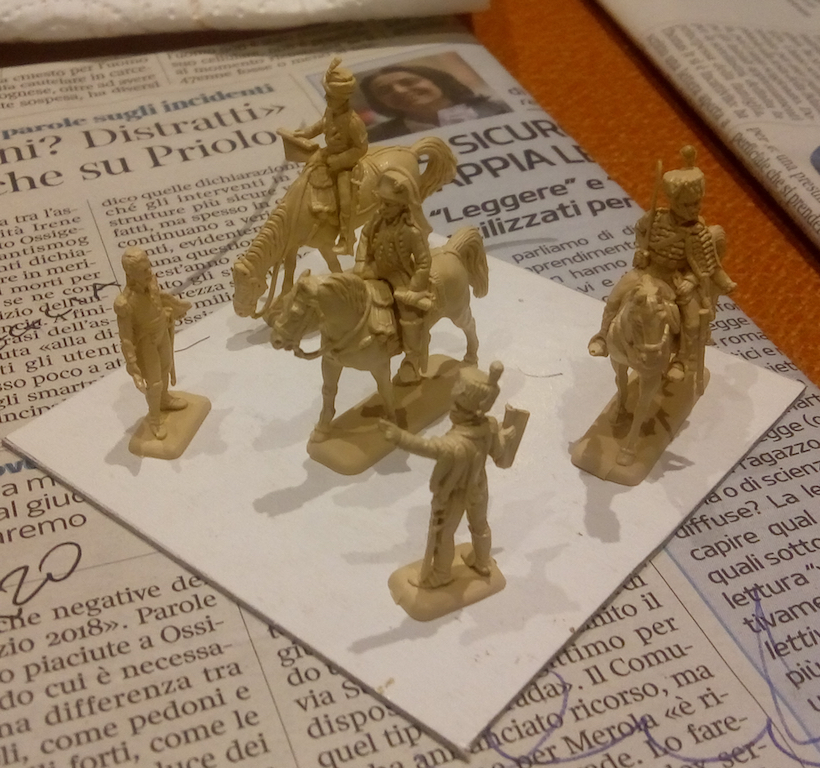
Napoleon's Imperial General Staff - on a 3" x 3" base

A.     Setting up for Play

The main changes here relate to units basing and unit size representation. My units (remember I play mostly with 1/72 plastic minis) are already based for OHW and I’ll retain that basing for both aesthetic and practical reasons.
Units are therefore based as:       
Infantry                  10cm x 5cm (4” x 2”), usually 12 figures in 2 ranks
            Cavalry                   10cm x 5cm, (4” x 2”), usually 6 figures (5 figures in some cases) in 1 rank
            Artillery                  5cm x 5cm (2” x 2”), usually 1 gun and 3-4 figures.
Of course you can play with a more standard (for GA) unit base size of 3”x 3” (7,5cm x 7,5cm) or 3”x 2” (7,5cm x 5cm), I just don’t want to rebase and like them as they are now!
For leaders, OHW doesn’t need any, so I mostly use the Grande Armée basing scheme for 25mm figures, as it’s already appropriate for my minis size:
                  C-in-C                      7,5cm x 7,5cm (3” x 3”), with at least 3 figures
                  Sub-Co                     5cm x 5cm (2” x 2”), with 2 figures
                  Generals/ADCs        TBD, with 1 figure (a small difference from the GA scheme)
Also, in order to be able to play even large battles with a reduced table size and number of minis, I generally consider 1 unit = 1 division or equivalent (instead of 1 unit = 1 brigade). Considering the game is from the Army Commander’s perspective, two levels  down from it is exactly the division level, so it makes sense from that perspective too. For artillery, only major batteries will be represented, or those who had a distinct impact, which may mean a reduction of artillery units in respect to those indicated by a traditional GA scenario (see also changes to section F later).
Cavalry is differentiated between Heavy Cavalry (HC) and Light Cavalry (LC), this has an effect on movement and combat.  It may be difficult to evaluate where Dragoons fit in this… I generally classify them as Light Cavalry because, as explained in the GA rulebook too, they mounted smaller horses than HC, charged more loosely and were not up to Cuirassiers in close combat terms (which is the main distinction at this scale), but feel free to disagree.
For smaller battles, I will retain the 1 unit = 1 brigade or equivalent standard representation, so I can still play all kind of battles.

B. Playing the Game

Will use this as it is, even if for the turn # correspondence with parts of the day I will use the handy FPGA equivalence. Very little will change in actual game terms however: if a game only lasts a few turns, it means the battle has likely started later in the day. And it works for a random choice of starting time and game length for non-historical battles.

C. Weather

Will use this as it is, even if effects on movement will have to be checked in respect to changes to section H.

D. The Command Phase

Will use this as it is.

E. Skirmishing

Will use this as it is. I will evaluate whether Sk2 units should use 10cm range as Sk1, to keep everything more consistent and, therefore, faster to play (unless it breaks balance a lot).

F. Artillery

Will mostly use this as it is, but I will only differentiate between Heavy Artillery (mainly 12pdrs) and Medium Artillery, and generally only related to corps batteries or large concentrations. Light Artillery will be mostly included into units. Distinction between “horse” and “field” artillery will remain for movement.

G. The Control Segment

Will use this as it is.

H. The Movement Segment

This is one of the two sections where I make most of the changes. I’m going with a Neil Thomas’-inspired approach where you can simplify the mechanics and still get most of what is needed to correctly represent what happens, especially given the scale.
First of all, all movement rates will be in cm, not in inches, in order to allow me to use a smaller table. Given that units now are divisions, disruption will be minimal and still give the proper “feel”. I’m still evaluating if cavalry needs to be a bit faster, but I’ll have to playtest it first so for now I won’t change it.
Normal movement is fixed, like in FPGA, and I will retain the distinction between fast and slow foot. Only when crossing difficult terrain or being within 10cm (4”) of the enemy I will use the random roll movement. Therefore, the Terrain Table is discarded.
Units don’t wheel, but pivot on their centers, like in NT’s rulesets. It’s a smart mechanics that gives the same end result but is faster and easier to play.
The 6” rule becomes the 4” rule (4”, or 10cm, is exactly 1BW and I like the correspondence). I keep the requirement for units to only move forward or backwards or pivot, but I drop the friction rule that is too time consuming for very little added realism.
Cavalry can’t evade, and Artillery can’t evade. It’s made to simplify two mechanics that are always slow and troublesome to play (for very little added realism at this scale).

I. Combat

This is the other section where I make most of the changes. I generally go for a more “Blucher-like” (but also NT-like, since I feel that’s where Sam Mustafa may have taken some ideas from) approach, even if I’ll retain a few concepts from GA.
As in GA, square up attacker’s base to the defender. No more than 1 attacker per defender’s base side. No more than 2 attackers for each defender, total. Attacker needs to have at least 2SPs left.
Roll 1 die per number of SPs
Add 1 die if (all that apply):          MX brigade not in or attacking towns or entrenchments
                                                       (V) officer using its bonus
                                                       Units is entrenched
                                                       HC vs LC
Subtract 1 die if (all that apply):                 Attacking uphill
                                                                    In difficult terrain
                                                                    Vulnerable (as defined in GA)
                                                                    Attacked by combined arms
Roll dice. Each die scores a “hit” on 4+
If defender is flanked: defender re-rolls hits (once)
Infantry vs Cavalry: Infantry doesn’t retreat, no matter the result. Can’t be flanked, but can suffer combined arms attack if attacked by Cav and Inf on same impulse.
Combat results: basically, the attacker wins the combat if it scores more hits than the defender. If it scores less or equal to the defender, the defender wins. However, if the defender is too weak (has 1SP left), it may prove unable to stop the attacker anyway. The attacker, too, will always suffer at least 1 SP. In detail:

First, check the Defender:
         If Defender more or equal hits than Attacker: Defender loses 1SP. If broken, remove
               If Defender less hits than Attacker: Defender loses #SPs equal to difference in hits. If broken, remove; if not broken, retreat

Second, check the Attacker:
         If Defender more or equal hits than Attacker: Attacker loses 2SP. If broken, remove; if not broken, retreat
               If Defender less hits than Attacker: Attacker loses 1SP, may advance if no defenders remain in contact.

Retreat distance: 3” + difference in SP loss (in inches). For cms: 7,5 cm + (difference in SP loss * 2,5cm)
(example: difference in SP loss is 1; retreat is 4 inches or 10cm)

J. Things Fall Apart

Will use this mostly as it is, but broken/routed units can’t rally: they are instead directly eliminated the moment they are reduced to 0 SPs.

K. The Rally Segment

I will discard this section entirely: units don’t rally during the battle. While I see what the author was aiming for with this rule, it adds a slowing down mechanics with, again, reduced historical relevance at this scale. Simply said, it’s not worth it (personal opinion of course!). Due to this, any training rating for units is discarded.

L. Victory

Will use this as it is, as it still allows rallying at day’s end if the battle is a multi-day one, which I feel is more appropriate.

M. Special Cases

Will use this as it is, if/when needed. Maybe I could amend something, but I prefer to wait unit I need to use anything from this section and see directly if it’s ok as it is or needs some changes. So far I’m not going to tweak anything here.

N. Optional Rules

Will use this as it is, even if I don’t plan to use these optional rules much. Therefore, like section M, I’ll see if they need changes only on an ad-hoc basis, no need to do it now.


giovedì 27 dicembre 2018

Making Grande Armee fast... or, at least, faster...

I've tested my Napoleonics SiP rules a few more times... and as it often happens when you really playtest something, I can now see what it does well and what it doesn't.

Pros: it really is a fast ruleset, that mirrors the original SiP system and gives a more Napoleonic feel. You can easily use it for OHW's scenarios, or for other teasers.

Cons: 
- the shooting rules have to be a bit changed, because they provided for too many casualties. A unit could just stay back and shoot the enemy until it breaks, without the need for close combat, because it's safer and usually assures destruction, even if not quickly. Close combat is useful only if you are in a hurry and/or if the enemy is already really weakened or in a bad tactical situation. Unfortunately, this may be not enough historical, as under this scale, skirmishing fire was a good thing to soften the enemy but close combat was what effectively drove the enemy away. A solution for this would be to reduce the likelihood of hitting for each die by 1: normal 5-6, skirmishing advantage 4-6, ancien regime 6. Or even reduce it even more to normal 6, skirmishing advantage 5-6 and no fire for ancien regime armies (which would actually fire more under close combat circumstances anyway). This would make it more likely for players to choose to close attack when near the enemy, while still allowing the skirmishing effect.

- army command and control. It works fairly well for a OHW- or teaser-like scenario of 10 units each or less without reinforcements, but is less useful when battles are more complex or with more units. Somehow the idea is sound but some of the flavor is lost and if reinforcements arrive, you have to recalculate the number of units each side can control.

Conclusions: good rules for fast, small games, but only if you take the modifications above for shooting. And the command rules may prove unsatisfactory to some players or in some battle scenarios.


Grande Armee rules, by Sam Mustafa
I've been looking for alternatives and I've found the Grande Armee rules, by Sam Mustafa. They are the predecessors of Blucher, and they are not supported anymore, but I think they do lots of things better than Blucher - but not everything. The way it deals with skirmishing, in particular, is excellent, better than in Blucher and fits my needs perfectly. Still, some other parts are less good, like the close combat rules, where Blucher definitely shows improvements. Also, the movement rules are a bit cumbersome. The command system is sound and interesting. I guess Sam moved to Blucher to improve the game - and he did in several areas - but also had to sacrifice some historicity (the volley fire part in Blucher is no more a part of close combat, which doesn't really make sense...) for more gamey solutions that would appeal more to wargamers.

In order to get a ruleset for larger battles, that would be less easy to fight with Napoleonic SiP, I'm toying with a fast versione of Grande Armee (no, not the Fast Play Grande Armee system that Sam Mustafa once wrote, because the rule changes don't give the same feel and don't appear "fast" at all...)

Therefore, I think I'll use the Grande Armee framework, starting with the Command and Control system, even if I'm thinking about a more elegant way of recording Cps spent than using the counters.

Blucher rules, by Sam Mustafa
The skirmishing and artillery fire part is good and would be used "as it is". For close combat, I would use the system from Blucher, which is more elegant, and for movement I'd use the SiP/Neil Thomas conventions, which make it much faster and straightforward, speeding things up.
Also, I would give up the training rating for units, keeping only the SP rating, just as Blucher does with the élan.

The biggest plus of playing with Grande Armee or Blucher is the great amount of author- and player-made scenarios available, which are easily adaptable to either!

Going to playtest this soon and see if it really works!

mercoledì 7 novembre 2018

Napoleonic Wargame Rules - Extra rules

In this final post for my Napoleonic Wargame Rules based on Simplicity in Practice (SiP), here I deal with some extra rules and bits.

Rally

The Rally rule is inspired mostly by Steven Whitesell's Napoleonic Grand Tactical OHW Rules. If a unit has a General attached, is at least 25cm from the closest enemy units (meaning it's in the rear) and has not fought in this turn (fire or close combat), it can try to reorganize/rally. It's a slow process... entire armies usually didn't have the time to properly reorganize within the same battle, unless a lull arrived (which would mean a second game in game terms), but smaller formations could - brigades and regiments could reorganize after being repulsed (either in attack or defense) if the enemy didn't press them too closely, allowing another later effort. Successful troops instead could be spent from the effort and need rest and reorganization.

It can't be thought of as something "automatic": it took time, efforts by charismatic officers and NCOs and could fail if men were too panicked, had scattered too much, were very tired even if successful or if a good part of the lower command structure was missing - making it harder to get soldiers in formation (and at least partially motivated) again. Accordingly, you can only try to rally 1 unit at a time, with a General attached - meaning it's a trade-off, because he can't do anything else that turn too - and it's not sure it will work.

A unit with an attached General that is at least 30cm away from the closest enemy unit and didn’t fire or fight in close combat can rally. 
Roll 1d6: 1-3 = no effect; 4-5 = -1DP; 6 = -2DP.

If rally fails, you can imagine it's taking lots of time because men are scattered and hard to recall and put in formation, or fail to be motivated enough to get back into line/resume attacking. A successful unit could have its men too tired and not willing to go further, or on the brink of collapsing. You can never get back a destroyed unit - it's been routed and/or completely scattered, and reorganizing it would take too much time meaning it won't be possible until after the battle (and if it lost the battle, even that could be next to impossible if they are pursued).

Unit Morale

French Old Guard - Art by Giuseppe Rava
Keeping in line with Neil Thomas' idea that you shouldn't "duplicate" an advantage/disadvantage, I've thought a lot about how to represent Elite/Guard troops and Levy/Poor ones. In the end, so far I'm keeping the SiP rules as written: elite/guard troops considered to have 1 less DP than their real rating, and have levy troops already with 1DP at start of battle.

At first, however, I thought about making elite troops harder to get a DP (like a -1DRM when you roll for DP) and levy troops easier (+1DRM). It would make it harder for elite/guard troops to get DPs and therefore be eliminated, and easier for levy units. Then, for close combat, units would roll dices depending on their current DPs (like 4 die minus number of DPs) instead of a fixed number, which would both reflect current disorder/motivation and be influenced by the fact a guard unit would more likely be in a better shape. In this case I would take away the "less DPs than opponent" advantage, as it would be already covered, while other advantages would remain.

In this way, better troops would stand fire better, and be more effective in close combat, unless already beaten up.

In the end, I'm still evaluating this... as I fear it may break some of the assumptions behind the original SiP rules that made real tactics the best ones to employ, always a good thing. So I think I'll have to playlets the variant version, to see if it works. Otherwise, I'll keep the original SiP system. My idea could look more accurate, but if the end result is roughly the same it may not be worth it.

An intermediate solution would be to keep the original SiP system and just add the -1DRM for elite troops when they roll for taking DPs. Similar result, and would just make them harder to disorder when fired upon. Not sure if this would make them harder. Again, something to work on through playtest!


Small units/Detachments

Not sure if I'll ever use this rule, but if I do, I'm leaving it as in SiP. It works fine and there's no need to fix it, especially given the limited use it will likely have. I have no rules for oversize units either... if big enough to warrant being divided into 2 units, then it will be 2 units. If not big enough for that, it would just stay and act as a single normal unit, the size difference issue with opponents usually being mostly not relevant in front of other elements.

lunedì 5 novembre 2018

Napoleonic Wargame Rules - Movement, Firing and Close Combat

Movement

I think the SiP rules for movement work just fine, and therefore we can refer to their design notes. Regarding differences, with no "light" independent units, we have normal infantry can enter woods and difficult terrain too, at half usual rate. Brigades attacking woods would send their skirmishers first, and increase them as needed, but there are no instances of units being "blocked" by woods (at least as far as I know).

I'm still wondering about making the requirements for road movement a bit stricter, meaning units moving have to remain at least 25-30cm away from the enemy, because 20cm (the distance indicated in SiP) is also the cavalry rate, which would still make them within charge distance.


Firing

Here's the part where I think most miniature wargames are wrong or at least not-so-accurate. I won't go into detail here, because it's perfectly explained here and further discussed here (a more general treatise on Napoleonic infantry warfare being found here instead). It's the real key of the Napoleonic warfare.

French Voltiguers - Art by Giuseppe Rava
Therefore, ultimately it makes not sense to have skirmishing fire, volley fire and close combat that is very common to many rules (including Blucher). Why? Because most long range infantry fire was by skirmishers, and volley was mostly performed at close range when one side's skirmishers were driven away, rest of that side's unit still stood its ground despite being sniped at by opposing skirmishers, and the other unit had to close. Often, units didn't even volley fire, as one side or the other just fled due to skirmisher fire and the sight of the other side's firm close order unit. When units fired volleys, it was at close range, and hand-to-hand combat between non-fleeing infantry units was nonexistent: one units would flee before that happened.

Under these premises, any "close combat" already takes into account most (if not all) volley fire. Longer range than that, it would be skirmishing fire and attached artillery.

So in this ruleset any fire is considered to be that of skirmishers and artillery attached to units, with the occasional long range volley fire (did they ever happen?), using SiP rules, with some modifiers, mainly to account for armies which had better and/or more numerous skirmishers, or armies which hadn't (like ancien régime ones).

Each unit rolls 4 dice. Each die will register a hit on the following scores: INF, AT = 4 – 6. 
+1DRM if Skirmisher Advantage
-1DRM if Ancien Régime unit firing or firing against deployed AT

In other words, units with good skirmishers hit on 3+, and Ancien Régime armies would hit at 5+ (their general lack of skirmishers being an additional vulnerability in a fight against Napoleonic French infantry. Everyone else would hit at 4+. Every unit rolls 4 dice as normal.

A battle would be attritional, with victory going to whoever had the last reserves and would use them at the right place in the right moment.


Close Combat

For cavalry, close combat would indeed include hand-to-hand combat, but for infantry, as explained above, it would be mainly about close-range volley fire and seeing which unit would be the one to keep steady and which one would flee first. It's mostly based on SiP rules, but with some modifications. First of all, you do not sum all dice, but roll each dice and see if it hits (at 4+). The one causing more hits wins the combat, with ties going in the defender's favor.

Each side rolls 4 dice, and all "advantages" afford 2 more dices each. Only attacking the flank/rear of a unit gives 4 more dice instead of 2. There are no dragoons, so for cavalry only the HC advantage against LC is counted.

Each side rolls 4 dice.
Each side rolls 2 additional dice for each of the following conditions that apply:
• Defenders with terrain advantage
• Fewer DP than enemy unit
• General attached
• INF defending against INF with same number of DP
• HC fighting LC
Each side rolls 4 additional dice for each of the following conditions that apply:
• Attacker if attacking flank/rear of enemy unit

Each die hits on 4+.

Units can retreat over friendly units, but take 1 more DP (this is taken from Steven Whitesell's rules), as long as they do not end in difficult terrain - otherwise they're destroyed. Considering a losing units already takes 2DP, retreating over friendly units may well prove fatal anyway.

French 4th Hussars at Friedland - by E. Detaille
Regarding squares, first of all even if the term "square" is more common for ease of use, actually not all armies used squares. Austria for example used "masses", so the term "prepared", as used in Blucher, may be more correct. Regardless of the exact term used - as long as all players know what is intended - there's a need for a formation which infantry can adopt to resist cavalry. During movement, instead of moving, a unit can form square/mass/be prepared (just "square" from now on for simplicity of writing). Using a procedure inspired by the one in Blucher, if attacked by cavalry while in square, cavalry units have to reroll their hits. If instead infantry is attacked by cavalry while not in square, it's infantry which has to reroll hits.

I thought a lot about this. OHW just has units in square unassailable by cavalry. This looks a bit too extreme, even if you can imagine such a situation including both confrontation and small ineffective charges - which ultimately compare to a stand-off. Anyway, while an understandable abstraction for a very simple ruleset like OHW, I prefer a simple alternative that still allows combat, including the possibility of cavalry breaking squares even if of course it would be hard. Remarkably, the effect is still similar and realistic enough: if an infantry unit isn't in square, cavalry will see it as a vulnerable target. If instead it is in square, cavalry is likely to avoid charging, given the difficulty.

One final note on moving and squares: squares can't move - as shown in OHW - but actually I'm thinking about giving them a movement allowance of max 2-2.5cm (roughly the 1" movement squares have in Napoleon's Battles) in open ground only. I'll verify through play testing.

Next: Extra Rules

giovedì 1 novembre 2018

Napoleonic Wargame Rules - Command and Control

Command and Control

I've always liked command and control mechanics with a traditional command radius + initiative rating for subordinate commanders, often used in miniature (Napoleon0s Battles) or board (Battles from the Age of Reason by Clash of Arms) wargames. I found it simple and realistic, and the individual leaders rating put some historical perspective on armies, as good commanders (like Davout, or von Seydlitz) can operate well even outside their OC radius, while poor ones would struggle. Problem is that such a system usually ends up becoming a complicated exercise in micromanaging distances as each general is placed at carefully measured distances in order to maximize army control: in short, it becomes an exercise in measuring and all too often it takes up valuable game time and scenario exceptions need cumbersome ad-hoc rules to work.

In the end, however, we have to keep in mind that any command and control system leads (or should lead) to the same end result: an army with good generals and/or a good staff and command system can manage and move its forces more readily, more efficiently and in a more coordinated way than an army with poor generals and/or a poor staff and command system. The only difference across the various ruleset is how many rules the game designer felt were needed to get to that same result.

Napoleon at Borodino - by V. Vereshagin
Therefore, in order to keep rules quick and yet obtain the same historicity, I decided to drop command radius and individual unit initiative ratings. If using scenarios which already state restrictions for command (like many scenarios in One Hour Wargames - OHW), players may stick to those and not apply anything else - or risk altering scenario balance. If no indications are given, or players anyway prefer to introduce an additional effect, then we can use NT's command rules from W19thCE. Each army is rated for its command level (mixture of leaders quality and staff work): Poor, Average and Good. This should be evident from historical references, but in case of doubt or disagreement, just stick with Average for both armies (or Good for both if preferring a more controlled game).

At the start of each own turn, the acting player rolls 1d6 and checks a table which gives him/her the number of units that are "in command" during that turn depending on his/her army command quality. "In command" means that they can function at full efficiency, either because they are within the chain of command or because a good leader is leading them (or both). After rolling, the active player names which units are "in command".

"Out of command" units are not idle however. They can move up to 1/2 movement allowance and fire using 1/2 the normal dice. They can't attack (go into close combat with) the enemy, but they fight normally if attacked. This is taken directly from NT's W19thCE.

For example, for a 10-unit army:

Army command quality
PoorAverageGood
1d6 roll1-22 (20%)4 (40%)6 (60%)
3-43( 30%)5 (50%)7 (70%)
5-64 (40%)6 (60%)8 (80%)

If armies are not composed by 10 units, use the % in brackets, rounding to the nearest whole number. So, for example, for a 6-unit army (like those for OHW when no particular rules are indicated):


Army command quality
PoorAverageGood
1d6 roll1-21 (20%)2 (40%)4 (60%)
3-42( 30%)3 (50%)4 (70%)
5-62 (40%)4 (60%)5 (80%)

Generals

The above emphasis on avoiding traditional command & control rules means traditional bases with general figures are mostly unnecessary (except for aesthetic reasons). However, I feel there may still be place for having a general miniature with some effective use. In this, I take ideas both from Blucher and from Steven Whitesell (of the interesting "Sound Officers Call!" wargame blog), in particular from his One Hour Grand Tactical rules.

Therefore each army still has one general base/model, roughly representing the Army Commander or anyway relevant commanders. Every turn, it can do one of three different things, and is placed accordingly so that players immediately remember what the leader is doing:

1) Command: General is at HQ and is concentrating on leading the battle, including with the help of his staff and subordinates). The general base is placed anywhere (likely behind his lines) but without touching any unit. The army has +1 "in command" unit this turn. Note that it's +1 unit, not +1 to the die roll. So for example a 10-unit army with an average command quality rolls 1d6 and gets 3: it should have 5 units "in command". But its general is performing its Command ability so it gets 1 more unit "in command". It therefore has 6 units "in command" this turn.

Wellington at Waterloo - by R. A. Hillingford
2) Lead unit: General is directly leading one unit, increasing its élan and leading it against the enemy, either in attack or defense. The general base is placed in contact with the friendly unit (only 1 unit!), which can be a different one each turn if so desired. That unit gets a close combat bonus for this turn (see Close Combat rules). If the unit is routed/eliminated (i.e.: gets to 4 DPs) then the general is lost and can't be replaced. The army effectively has to do without a general from now on. This represents both the loss of a key leader (not necessarily the army CO) or of several valuable officers (or both), limiting the army's ability to coordinate and perform effectively as replacements struggle to take control of the situation.

3) Rally: General is busy trying to reorganize demoralized and/or disordered troops so they can get back into the fray. The general base is placed in contact with one friendly unit (only 1 unit!) that is at least 30cm apart from the closest enemy unit, and can be a different one each turn if so desired. It allows that unit to rally (see Rally rules).

These three options present a standard trade-off situation: you can have one advantage, but have to renounce to the others: either you get better control, but can't help in rallying or in a key combat; or you get a boost in a key combat situation, but control your army less well and risk losing the general if something goes awry; or you try to rally your troops but can't control your army well or give a hand in combat. In some situations (especially at start) it will be an easy choice, becoming more and more challenging as the battle evolves, like in real life.

Having the leader base moved directly in the desired position (foreign the usual movement rates, or other rules) effectively makes it a sort of "counter" that instantly shows what the player has chosen to do with it, and allows both simplicity and ease of use (and memory!).

I'm still thinking about using more than one general for larger games, but I still have to find a way to make them not too powerful, or denaturate the C&C rules.

Next: Movement, Firing and Close Combat